Can rapid methane emission reductions prevent permafrost thaw?
Code for this project can be found here. Manuscript is published here in Global Environmental Change Advances.
What is the role of methane mitigation in avoiding excessive warming?
Methane is a short-lived but powerful greenhouse gas. While there is agreement that long-lived carbon dioxide must be phased out immidiately, the timescale for methane phaseout is still under debate. We wonder if including climate feedbacks in this discussion could lead to more urgency. For example, could we prevent any climate feedback mechanisms from tipping into instability and releasing more GHGs, just by doubling down on our methane mitigation efforts this century? Since methane is a powerful short-term actor, perhaps phasing out methane rapidly could reduce warming not just through its own mechanism, but by the reduced warming sparing us from some further climate feedbacks. We'll begin to investigate this by looking at one climate feedback: the permafrost. The permafrost holds a very large store of carbon and will thaw as global temperature increases. It is not clear whether rapid methane phaseout could prevent enough warming to spare some permafrost (and subsequent emissions) to put us on a cooler path forwards.
We created a reduced complexity model of relevant Earth systems to capture dynamics between methane emissions, permafrost thaw, and long term surface temperature changes.
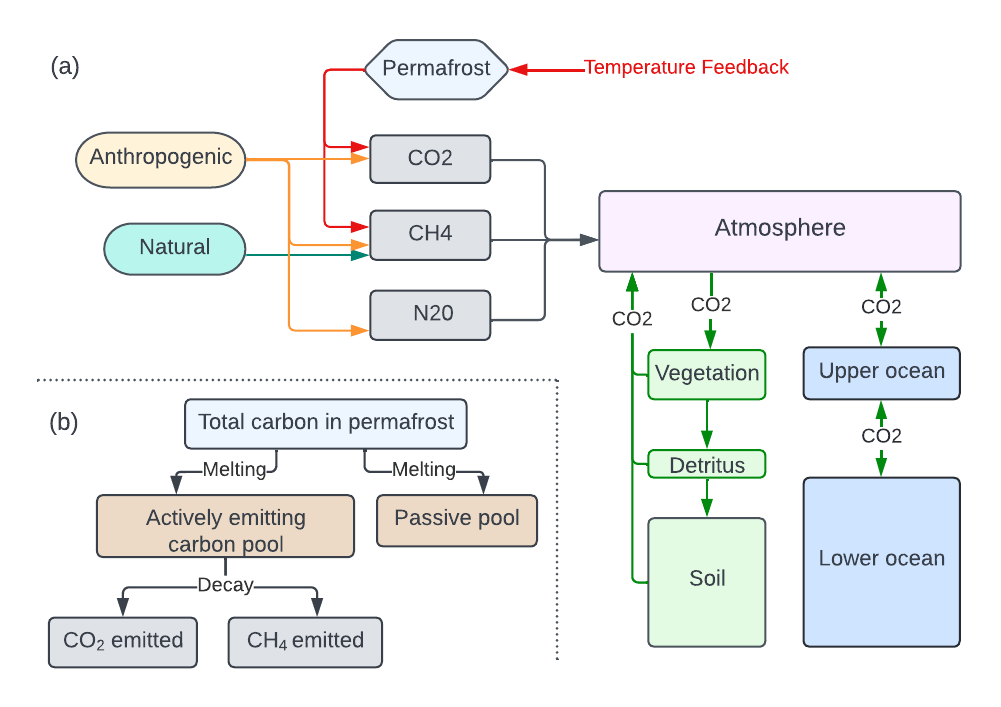
Our model describes radiative forcing, ocean layer heat transfer, the carbon cycle, and permafrost decomposition. These are represented internally as inter-coupled differential equations. To make our temperature projections, we started with Representative Concentration Pathways (RCPs), which are climate change scenarios with different emissions pathways. We used RCP 2.6, 4.5 and 6.0. We modified the methane emissions for these RCPs to our own varying methane schemes (1%, 5%, and 10% annual reductions).
First, we validated our model against historical records, and it recreates the dynamics we are interested in:
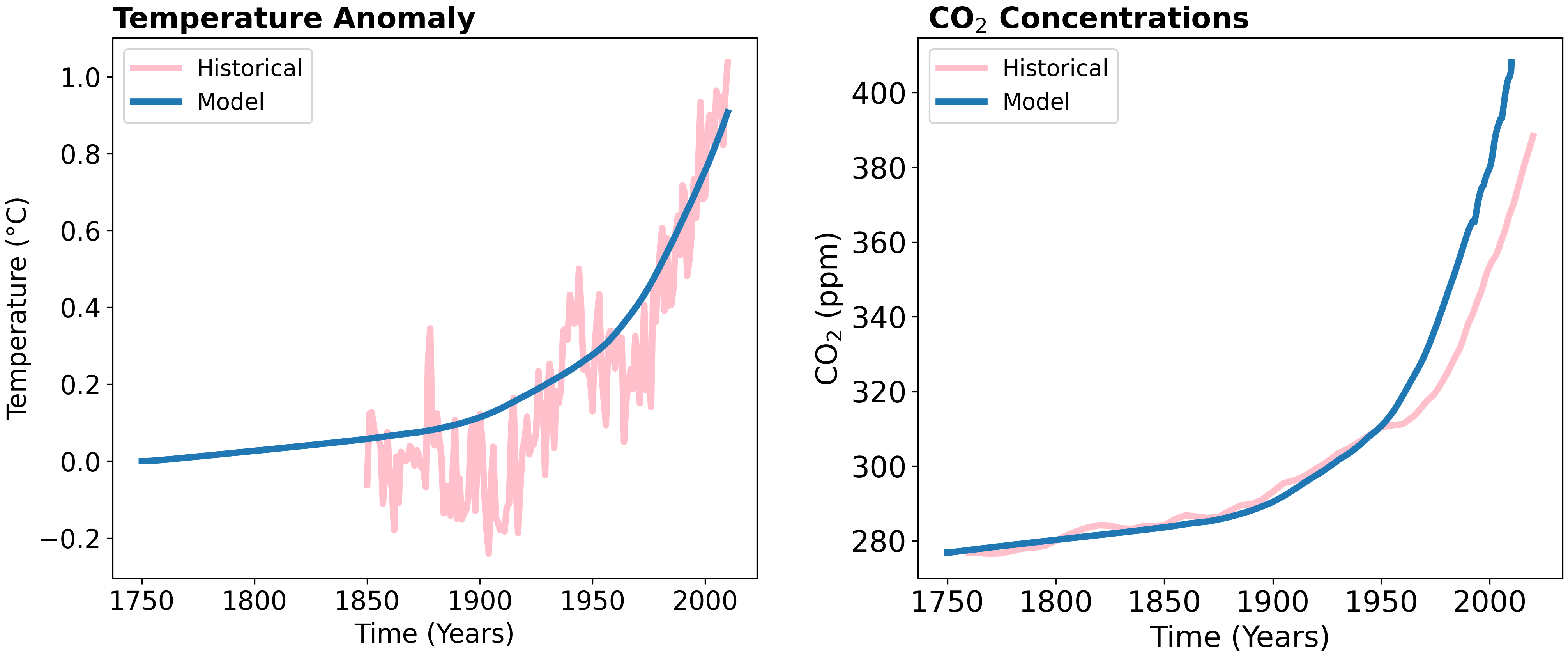
On the image right, our model predicts slightly higher CO2 concentrations because as atmospheric carbon increases, plants actually uptake more carbon. We used a fixed coefficient for this, but realistically it is variable (to a point) and has increased. However, the model is sufficient to describe the relationships we are interested in qualitatively.
Our model is implemented in python with object-oriented programming, which gives us flexibility to run many different scenarios. We use scipy’s solve_ivp to solve our coupled differential equations at any given timestep to produce to continuous projections.
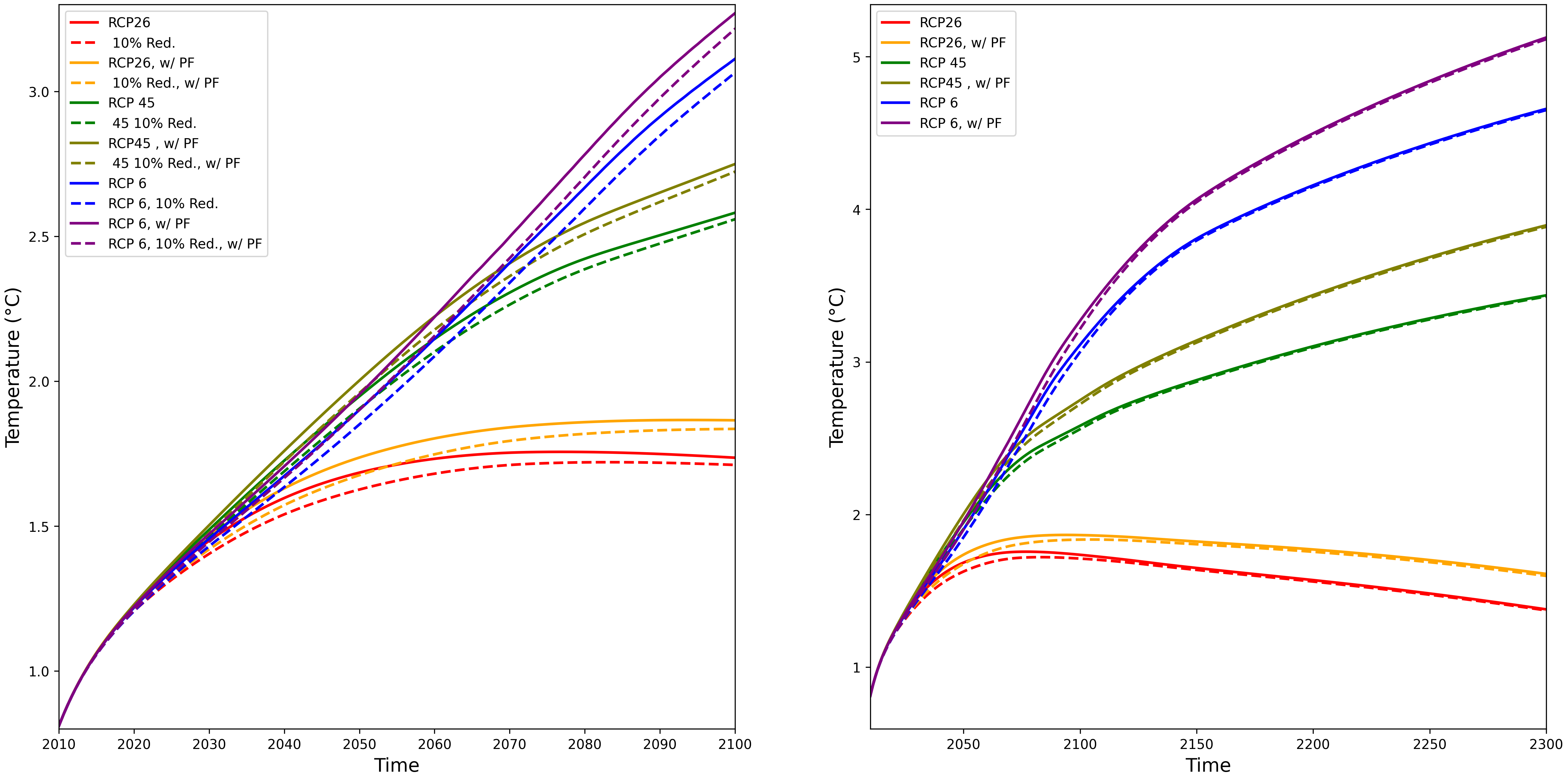
Rapid methane mitigation did not prevent or delay permafrost feedback, and therefore, did not result in a long term temperature reduction. Below shows the linear relationship between the magnitude of methane emissions to temperature, and the negligible impact of rate of reductions.
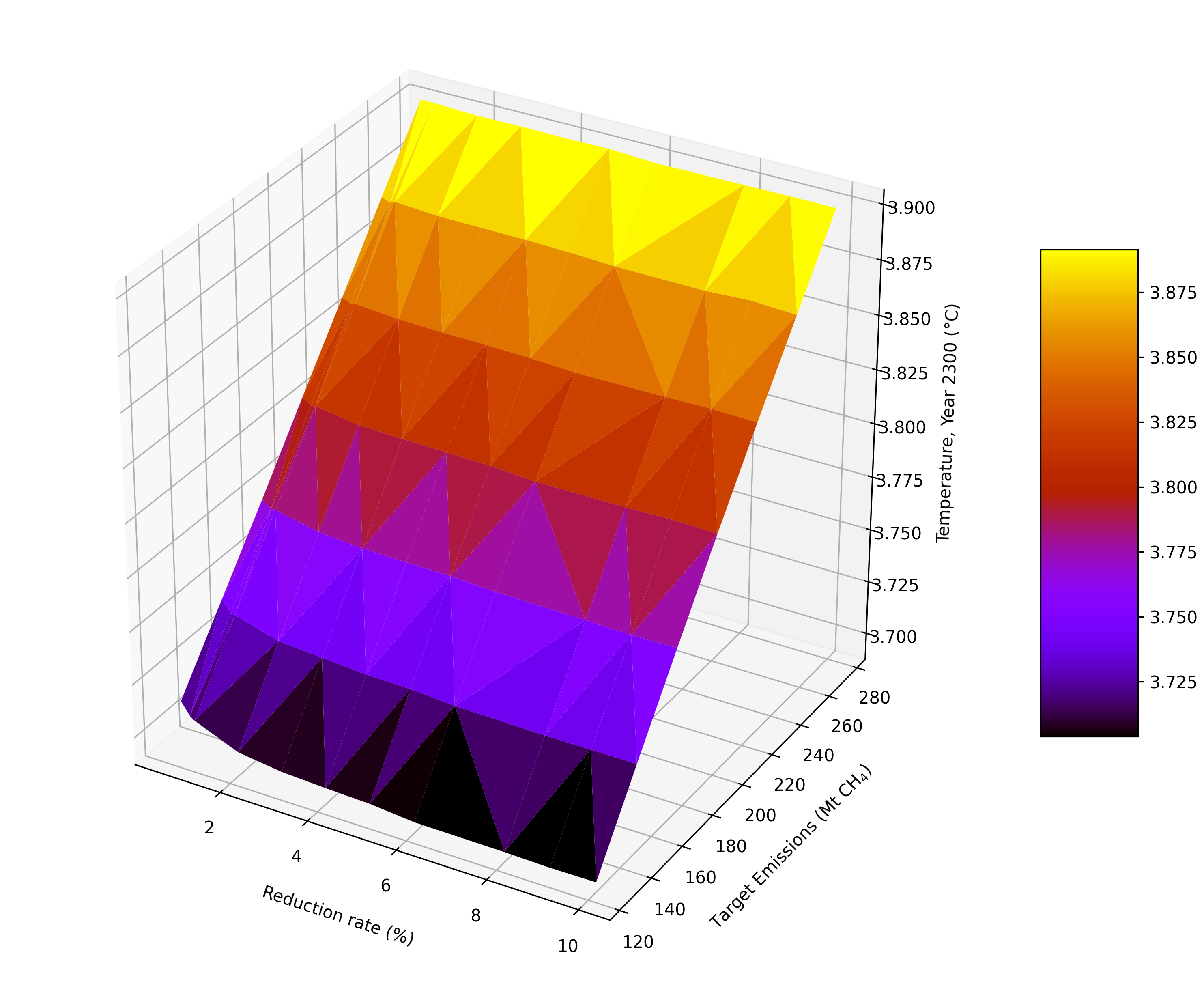
We learned that final emissions baseline (i.e., at year 2100, how much methane was being emitted) was the most important factor in determining long-term temperature change. The annual rate of reductions did not have much impact, so long as the rate of phaseout was fast enough to ensure we reached our desired target. However, further research is needed with more consideration of other methane dynamics.